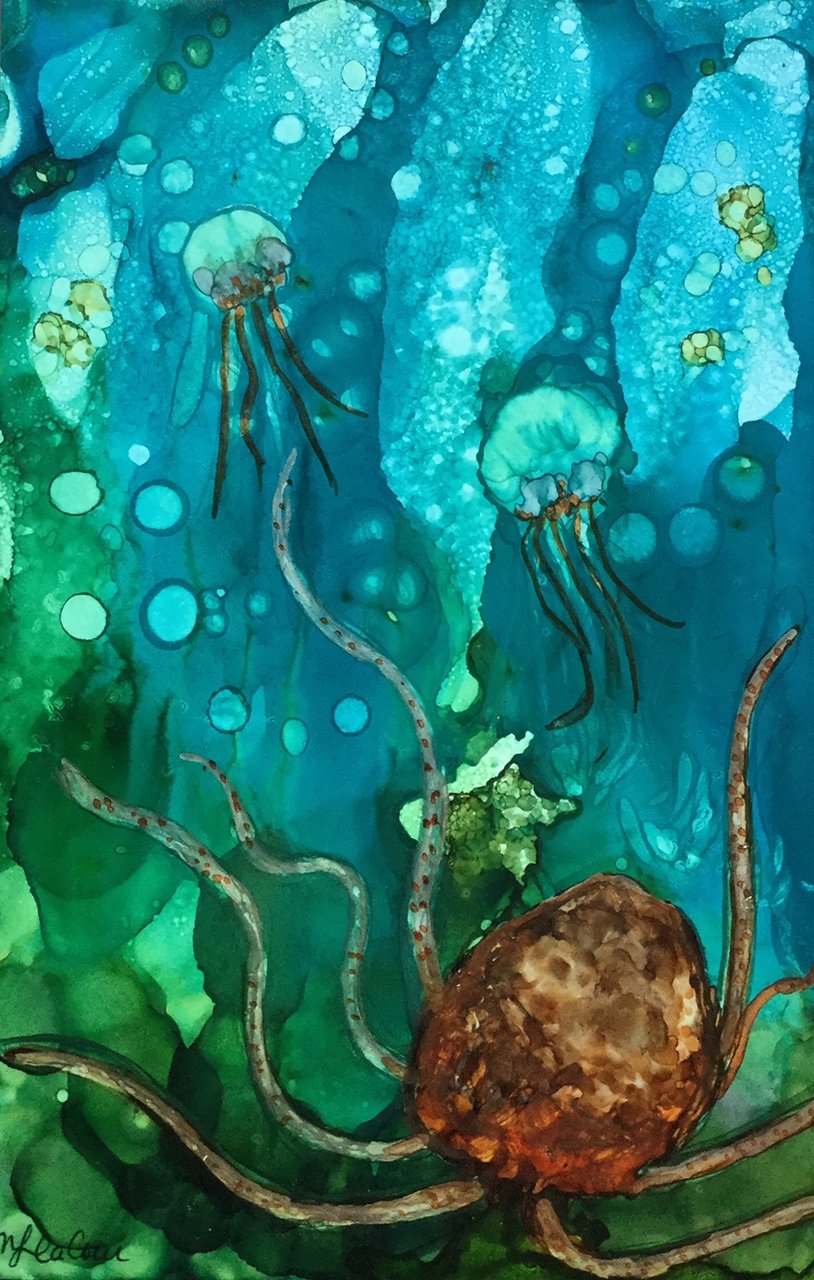
A picture may be worth a thousand words, but unless you can articulately describe it, the average person won’t buy it.
When selling your art, the verbal description is just as important as the visuals. Thorough, thought provoking descriptions are an essential piece of the selling puzzle. These descriptions tell the average person more about the piece.
Supposing you studied art and its history in a formal setting, then you probably learned the proper way to describe your artwork. Mainly, the visual elements including form, composition, medium, techniques, and subject matter.
Unfortunately, these formal descriptions don’t translate well for the average person. They’ll understand very little about your artwork which won’t translate well for you in terms of sales.
Your duty as a successful artist is to not only make a person feel through your work, but also make them feel through your words.
For the average person to understand your creations, you must describe your own art with more of a marketing approach. You must describe its features and benefits to make a connection between your art and the average person in order to make a sale.
Tips for Describing Art to the Average Person
Describe your artwork as if you were talking to someone who couldn’t see it.
Pretend the average person is blind. They can’t see anything. Not even shadows. Just because they’re blind doesn’t mean they can’t use their four other senses to feel your artwork.
Suppose you were trying to describe your painting of a bunch of stars. Instead of describing the color, describe how the stars would feel.
To accomplish this, tell your prospect that in order to feel stars they should put their hand out when it’s raining. Then, they can feel the little points fall down on their palms. Because rain falls so quickly it has the effect of ‘twinkling’.
The average person will become strongly connected to artwork they can feel using their imagination.
Describe the mood of your artwork as well as the visual characteristics.
Mood is an internal and rather subjective emotional state. Grammatically speaking, mood is a feature of verbs that’s used to indicate modality. There are several types of grammatical moods including indicative, interrogatory, imperative, emphatic, subjunctive, injunctive, optative, and potential. As an artist, you’ll want to grammatically describe the mood of your artwork using the indicative type. This type is used for factual statements and positive beliefs.
As you know, the visual characteristics of artwork are lines, colors, values, shapes, textures, space, and movement. To describe them, you must think beyond straight or curved, red or orange, light or dark, round or square, striped or polka dot, shallow or deep, and small or large. Instead, you must talk about these characteristics using much more descriptive adjectives.
To describe the mood and visual characteristics to the average person, ask yourself these questions:
- How does its ambiance feel?
- What undertones does it evoke?
- How does its essence effect your spirit?
The average person will become enchanted with your artwork when you talk about its mood using descriptive adjectives.
*If you have trouble with this, ask your friends to describe their feelings about your artwork using descriptive adjectives.
Always mention the colors, but make sure you use words that describe the colors and their effect.
For example, green is the color of grass, the leaves of trees, and seaweed. Green represents growth and healing. Red is the color of blood, roses, and hot chilis. It’s a very passionate color. Red can mean anger or desire.
Use words such as lustrous, shadowy, radiant, glossy, and saturated when describing colors. These words articulate the depth of the color.
The average person will see your artwork in a different light if you describe it using words that connect your artwork to the smell and feeling of everyday objects.
Put yourself in the mindset of the average person.
The average person knows little about art and your art-making process. For them, it all boils down to dollar bills.
The bad thing about the average person is that they earn money by doing things they don’t love. They have a lot of bills to pay. They don’t have the luxury of being creative. They don’t have a lot of money to spend on art.
But the great thing about the average person; they see money through the eyes of emotion. If they want something bad enough, they’ll find a way to get money to buy what they want.
What you have to do is create that emotional connection between your artwork and the average person.
Think about how you can make them FEEL your artwork with words.
The average person isn’t looking for a landscape painting filled with farmland and barns. Their soul’s yearning for a striking piece of artwork for their entranceway that’ll greet visitors with a warm blast of dazzling sunlight which conjures their memories of the many summer times they spent on grandpa’s farm. Complete with the intoxicating aroma of a freshly cut hayfield, and the glistening golden blades of hay.
The average person can feel artwork if it’s vividly described, creating an unwavering emotional connection.
Art isn’t passive. Use action words to describe it.
Richard Serra once said, “Drawing is a verb.” Using only sheets of paper, he created a list of the infinitives of 84 verbs including to roll, to crease, to fold, to store, etc. This list also provided 24 possible contexts within which these verbs could be used including of gravity, of entropy, of nature, etc. Serra described this list as a series of actions related to the artist and the creative process. He used it to guide himself while creating in multiple mediums.
To determine which action words to use when describing your artwork to the average person, ask yourself these questions:
-What does the piece do?
Perhaps it charms and inspires.
-What’ll the average person do with it?
Perhaps they’ll luxuriate in it.
-Does it make a statement?
Perhaps it creates a serene atmosphere.
The average person isn’t passive when it comes to buying art. They either love it or they don’t. Describe your creations using action words so the average person will take action and buy your art.
The use of words to describe artwork is completely subjective, and artwork may mean different things to different people. However, with effort, imagination, and practice, you can give the average person a more lively and interesting experience while viewing your art.
Autumn Tompkins is the owner/lead writer for ink well copy. She’s a nail-biting, Southern Comfort-loving, poker-playing, adventure-seeking, animal-adoring, tattoo addict who has a way with words. Writing to increase your revenue is her passion. You can find out more about her at InkWellCopy.com